
If you’re trying to figure out how to get out of debt in India, there’s a good chance you already know you’re in trouble. Maybe it’s three EMIs running simultaneously and you’re not sure how long you can keep juggling. Maybe you just did the math and realised your total debt is a number you don’t want to say out loud.
You’re not alone. Scroll through r/IndiaInvestments or r/personalfinanceindia on any given day, and you’ll find someone posting a version of the same question: “I’m in ₹X lakh of debt. Where do I even start?”
The advice they get is usually scattered. Some of it is good. Some of it contradicts other good advice. And most of it assumes you’re already calm enough to think clearly — which, if you’ve ever been deep in debt, you know is not how it works.
So here’s an attempt to lay it all out in the order it actually matters. Not the theoretical order. The practical one.
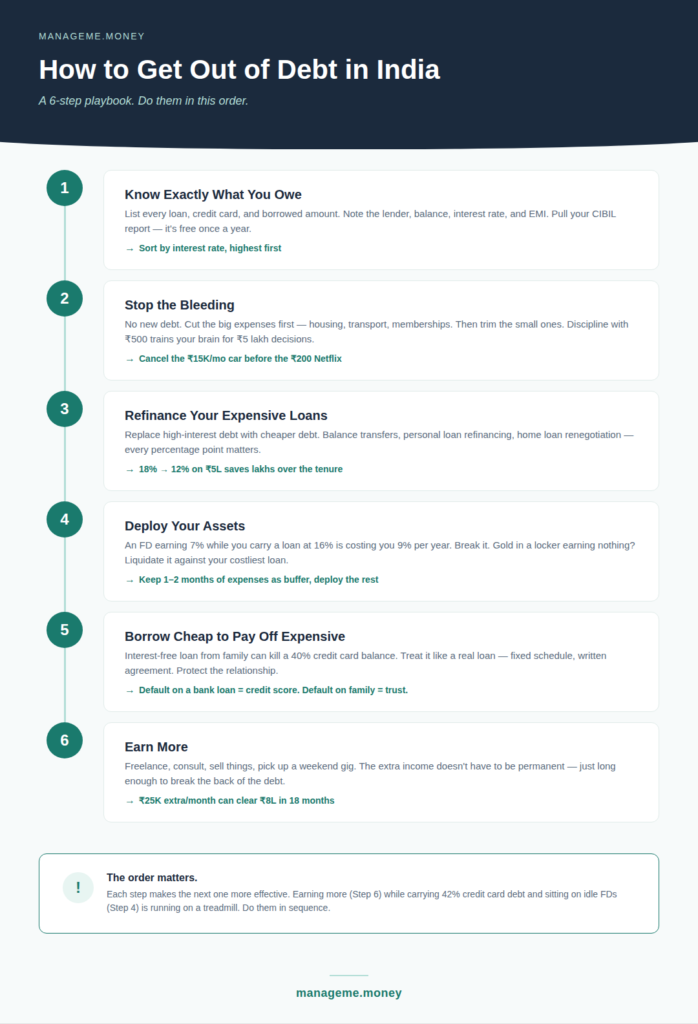
Step 1: Know Exactly What Your Loan Amount Is
Before anything else, you need a full picture. Not the rough number in your head — the actual number. Every loan, every credit card balance, every borrowed amount from family.
Write it down. All of it. For each debt, note four things: who you owe, how much, the interest rate, and the monthly payment (EMI or minimum due).
This is the step most people skip because it’s uncomfortable. The vague dread of “I owe a lot” is somehow easier to live with than the specific reality of “I owe ₹18.4 lakh across five accounts.” But you can’t fix what you can’t see.
If you have loans from banks and NBFCs, pull your credit report. It’ll show you every open account, outstanding balance, and whether you’ve missed any payments. Sometimes people discover loans they forgot about — or worse, loans they didn’t take.
Once you have the list, sort it by interest rate. Highest first. This becomes your attack sequence.
Step 2: Stop the Bleeding: No New Debt
You can’t fill a bucket with a hole in it. Before you start aggressively paying off debt, you need to plug the leaks.
This means two things.
First, stop taking on new debt. No new credit card purchases you can’t pay in full this month. No new personal loans to cover old personal loans (this is a trap that feels like a solution but isn’t). No Buy Now Pay Later unless it’s genuinely zero-interest and you have the money to pay it off.
Second, cut your expenses. Not just the small stuff — though that matters too — but the big recurring ones. This is where people get it backwards. They cancel their Netflix subscription (₹200/month) and feel virtuous, while still paying ₹15,000/month for a car they could sell. Or they agonise over food expenses while paying rent in a locality they can’t afford.
Look at the big three first: housing, transport, and lifestyle subscriptions or memberships. Can you move to a cheaper place? Can you downgrade your car or switch to public transport for a year? Can you pause that gym membership or club subscription?
Then look at the small stuff. Eating out, online shopping, impulse purchases. Not because ₹500 here and there is going to solve a ₹15 lakh problem, but because the discipline of watching small expenses trains your brain to be intentional about money. And that mindset shift is what makes everything else in this list possible.
Step 3: Refinance Your Expensive Loans
Not all debt is equally dangerous. A home loan at 8.5% is a completely different animal from a credit card balance at 42% or a personal loan at 18%.
The single most impactful thing you can do with high-interest debt is replace it with cheaper debt. This is refinancing, and it’s not complicated — it just requires some legwork.
Here’s what to look at:
If you have credit card debt, check if your bank offers a balance transfer to another card at a lower rate. Many banks run balance transfer promotions — sometimes as low as 2-3% for a limited period. Even if the promotional rate is temporary, it buys you breathing room to pay down the principal faster.
If you have a personal loan at 16-20%, check if another bank or NBFC will offer you a lower rate. Your CIBIL score matters here, but even with a mediocre score, you might find better rates than what you’re currently paying. The interest difference between 18% and 12% on a ₹5 lakh loan is not trivial — it’s lakhs over the loan tenure.
If you have a home loan, check if your current rate is competitive. Banks revise rates regularly, and if you took your loan three years ago, you might be paying more than today’s new borrowers. You can either negotiate with your existing bank or refinance with a new one.
The goal is simple: pay less interest on the same debt, so more of your money goes toward actually reducing what you owe.
Step 4: Use Your Assets Strategically
This is the step that makes people uncomfortable, but it’s often the most powerful one.
If you have a fixed deposit earning 7% while carrying a personal loan at 16%, you’re losing 9% every year by keeping that FD. The math is brutally clear: break the FD, pay off the loan, and you’ve just given yourself a 9% return.
Same logic applies to other assets. Gold sitting in a locker isn’t earning anything. Mutual fund investments that you can liquidate without a huge tax hit might be better deployed killing a high-interest loan than sitting in a portfolio that earns 12% while you’re paying 18% on a loan.
This doesn’t mean liquidate everything. You still need an emergency buffer — even a small one, say one to two months of expenses. And you shouldn’t sell assets at a loss if you can avoid it. But if you have idle assets earning less than your most expensive debt is costing you, the rational move is to redeploy them.
A common pattern on Indian personal finance forums: someone has ₹3 lakh in an FD “for safety” while carrying ₹4 lakh in credit card debt at 40% annual interest. That “safe” FD is actually costing them over ₹1 lakh a year in interest differential. Safety isn’t safety if it’s making you poorer.
Step 5: Can You Borrow Cheap to Pay Off Expensive Loans?
This one requires trust and humility, but it works. This is the only exception to Step 2.
If you have a family member or close friend who can lend you money at zero interest — or even low interest — to help you pay off a high-interest loan, that’s a legitimate financial strategy. You’re not “burdening” them if you have a clear repayment plan and you honour it.
The key is to treat it like a real loan. Agree on the amount, the repayment schedule, and put it in writing. Not because you don’t trust each other, but because money has a way of creating tension in relationships, and written agreements prevent misunderstandings.
A word of caution: only do this if you’re confident you can repay on time. Defaulting on a bank loan damages your credit score. Defaulting on a family loan damages something much harder to rebuild.
Step 6: Earn More
Everything so far has been about optimising what you already have. But sometimes — honestly, often — the real constraint isn’t how you manage money. It’s that there isn’t enough of it.
If your income minus your essential expenses barely covers your EMIs, no amount of refinancing or expense-cutting will get you out of debt fast enough. You need more money coming in.
This could look like different things depending on your situation. Freelancing on weekends in your area of expertise. Taking on a part-time consulting gig. Selling things you don’t need. Picking up delivery or driving work if that’s what’s available.
None of this is glamorous. But debt isn’t glamorous either. The person on Reddit who paid off ₹8 lakh in 18 months didn’t do it with one magic trick — they did it by earning an extra ₹25-30,000 a month through freelance work and throwing every rupee of it at their highest-interest loan.
The extra income doesn’t have to be permanent. It just has to last long enough to break the back of the debt. Once the most expensive loans are gone, the pressure drops dramatically, and you can go back to a more normal pace.
Why This Order Matters When Getting Out of Debt
If you try to earn more (Step 6) while still carrying 42% credit card debt and sitting on idle FDs (Step 4), you’re running on a treadmill. If you refinance your loans (Step 3) but don’t stop the spending habits that created the debt (Step 2), you’ll end up right back where you started.
Getting out of debt in India isn’t about one trick — it’s about doing the right things in the right sequence. Know what you owe, so you can stop the bleeding. Stop the bleeding, so refinancing actually helps. Refinance, so your assets go further when you deploy them. Deploy your assets, so the extra income you earn actually moves the needle instead of just covering interest payments.
One more thing. If you’re reading this and thinking “this is a lot,” it is. But you don’t have to do all of it at once. Start with Step 1 today. Just the list. Just the numbers. That single act of writing down what you owe — all of it, honestly — changes something in your head. It takes the problem from a shapeless cloud of anxiety to a finite, specific challenge with a finite, specific solution.
And finite problems can be solved.
If you want to understand where you stand financially — not just your debt, but across 16 different financial ratios including your EMI-to-income ratio, savings rate, and emergency fund coverage — you can try our free financial health assessment. It takes about 15 minutes and gives you a clear picture of what needs attention first.
Related reading: What Is a Financial Health Check? | Emergency Fund Calculator: How Much Do You Really Need?